
BRNet 2026 Recap — LinkedIn Article
LinkedIn Article Deliverable
Section titled “LinkedIn Article Deliverable”Account decision resolved (2026-07-14, Asia + Patrick): the article publishes from the Baseworks company page. Asia and Patrick then each reshare it from their personal accounts (reshare posts to be drafted below). The collective “we” voice stays; Asia is credited in the third person in the body, so no separate byline line is needed.
Cover image: choose a Padova conference photo from media.baseworks.com/website/events/2026-06-brnet-body-representation/ (the poster at close engagement, or the Palazzo del Bo courtyard).
Canonical URL (add at the bottom as a plain text line): https://baseworks.com/communications/brnet-2026-poster-and-panel-at-the-body-representation-network-meeting/
Note on the @-mention: the mention of Asia in the first paragraph must be retyped live in LinkedIn’s article editor (type @ and select her profile) — a pasted @Asia (Ksenia) Shcherbakova will not resolve. If the editor won’t resolve it, use the plain name.
SEO Title (LinkedIn article settings): Baseworks at BRNet: Three Trainable Components of Body Representation
SEO Description (≤160 chars): Baseworks presented findings on three trainable components of body representation and a gap in existing assessment tools at BRNet in Padova, 2026.
The article body below is the first portion of the published communications post, cut at a natural break before “The Field at BRNet,” followed by a preview paragraph and the canonical link. The venue history is trimmed for length.
Article body (copy-paste into LinkedIn)
Section titled “Article body (copy-paste into LinkedIn)”Baseworks at BRNet: Three Trainable Components of Body Representation
Section titled “Baseworks at BRNet: Three Trainable Components of Body Representation”In June 2026, we attended the 8th Annual Body Representation Network Meeting in Padova, Italy, where @Asia (Ksenia) Shcherbakova presented a poster based on our research and participated in a career panel for early-career researchers. The conference, themed “The Uncanny Body,” brought together neuroscientists, clinicians, and psychologists working on how the brain represents the body, what happens when that representation breaks down, and how to measure it.
The conference was held in the Palazzo del Bo, the historic main building of the University of Padova, founded in 1222. The first day’s sessions took place in the same hall where Galileo lectured during his eighteen years at Padova, and the same complex houses the world’s first permanent anatomical theatre, built in 1594. There was something fitting about having this conversation inside a building where the scientific study of the human body has an eight-century record.
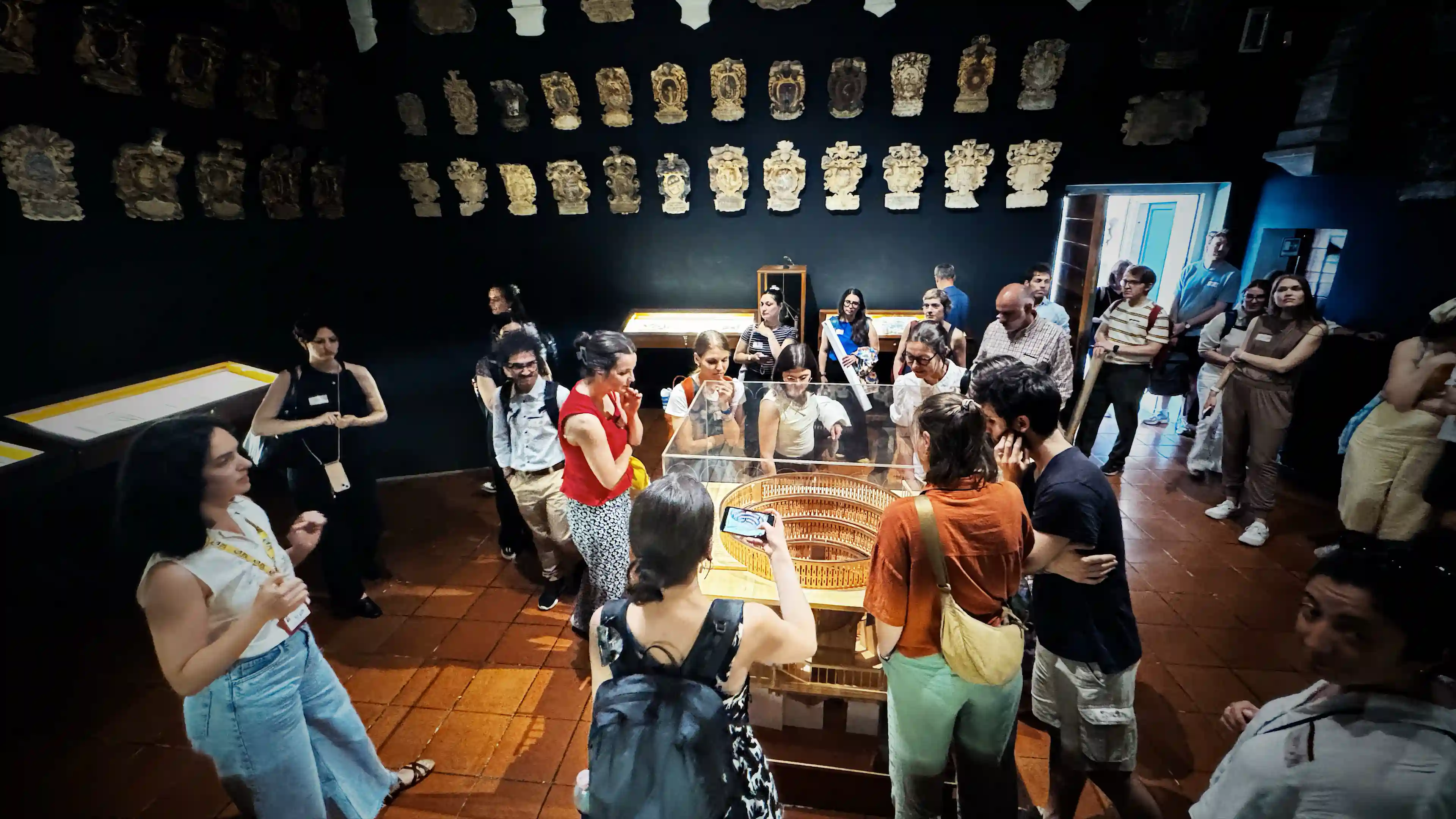 Conference attendees around the scale model of the University of Padova’s anatomical theatre, the world’s first, built in 1594.
The Baseworks Poster
Section titled “The Baseworks Poster”The poster was titled “Three Trainable Components of Body Representation: Evidence from a Decade of Naturalistic Perceptual Skills Training.”
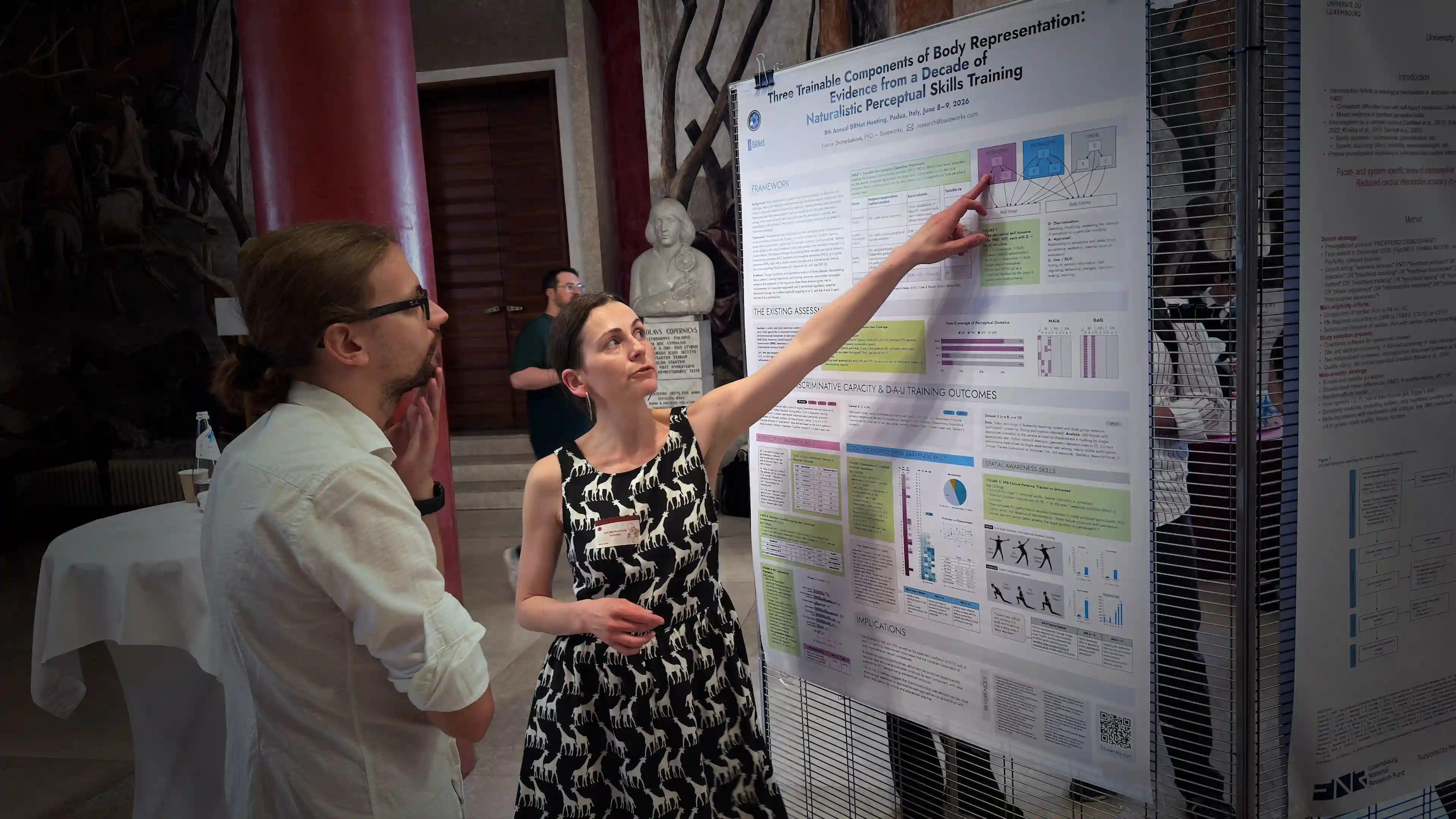 Asia Shcherbakova presenting the Baseworks poster at BRNet 2026.
The core argument: body representation isn’t something normally homogeneous that only breaks down in clinical populations. In healthy populations, certain aspects of it are systematically underdeveloped, in ways that only become visible when the demands of a training context exceed what’s available for representation. Many training tasks in Baseworks systematically create such pressure. Asia presented the latest iteration of our framework: three mechanistically distinct, trainable discrimination capacities, mapped onto body representation concepts. Each was presented with its own measurable failure pattern and training strategy, drawing on data from about ten years of Baseworks training with over 10,000 learners.
The three domains are as follows. We use the term “awareness” to emphasize their availability for conscious discrimination and monitoring.
Localized proprioceptive awareness. The ability to consciously detect spatially specific sensations arising from muscle. This capacity varies widely across individuals, even among people with extensive physical backgrounds. In our survey of non-practitioners, fewer than half reported awareness of muscular sensations at rest.
Spatial awareness. The capacity to encode, hold, and reproduce the configuration of the body without relying on visual feedback. In one of our analyzed datasets, people with no prior Baseworks training showed errors eight to fifteen times larger than trained practitioners on selected spatial configuration tasks. Baseworks almost entirely consists of tasks that look simple but are surprisingly difficult to perform.
Interoceptive awareness. The conscious awareness of internal states, including breathing, effort, stress, and metabolic changes. In physical practice, this functions as self-regulatory monitoring of breathing and effort. Many people are unable to use interoceptive sensations as predictors of allostatic load, and so cannot preemptively adjust the intensity of a movement task to avoid fatigue, pain, and soreness. This ability improves with targeted training.
Each of these three components also has an internal structure of three dimensions: discrimination (detecting and distinguishing patterns in sensory input), appraisal (the attitude toward what you’re sensing), and use (integrating that information into skilled movement or regulation). One of our datasets suggests discrimination is a necessary condition for the other two: developing discrimination supports spontaneous gains in appraisal and use, without any specific appraisal- or use-targeted training.
We also mapped our framework onto the four body-awareness questionnaires in wide scientific use. We showed that localized proprioceptive awareness and spatial awareness, as we define them in our framework, are absent across all four tools. Existing assessments focus almost entirely on interoception, and even there they tend to conflate discrimination with appraisal and use. Researchers designing studies that involve body representation in non-clinical populations are working without instruments for two of the three components our framework identifies.
The full recap continues on the Baseworks site. It covers the field at BRNet and where our data sits alongside it. It looks at several of the research presentations most relevant to our own work, from robotically induced presence hallucinations to body ownership after stroke. And it closes on Asia’s contribution to the early-career panel, where she described a research position she called the “residential scientist”: someone embedded inside a particular context long enough to know what actually needs measuring before designing lab studies.
Read the full recap at https://baseworks.com/communications/brnet-2026-poster-and-panel-at-the-body-representation-network-meeting/
Baseworks page share note (publishes with the article; finalized 2026-07-14, Asia’s edit)
Section titled “Baseworks page share note (publishes with the article; finalized 2026-07-14, Asia’s edit)”When the article is published from the Baseworks company page, LinkedIn creates a feed post announcing it. This is the commentary text for that post. Unified voice: third person, factual, no em dashes, no exclamation marks.
In June, Baseworks took part in the 8th Body Representation Network Meeting in Padova, Italy. Asia Shcherbakova presented the poster “Three Trainable Components of Body Representation” and joined the panel for early-career researchers.
The poster presents a framework that draws on about ten years of training data from more than 10,000 learners, supported by quantitative and qualitative analyses of several datasets. It describes three trainable perceptual capacities, each with a distinct failure pattern in healthy adults, and documents a gap in current assessment tools: two of the three capacities have no coverage in the four body-awareness questionnaires in wide scientific use.
The article below covers the poster and the meeting. The full recap is on the Baseworks site.
Personal reshare posts (Asia + Patrick)
Section titled “Personal reshare posts (Asia + Patrick)”Both posts use LinkedIn’s “Repost with your thoughts” on the Baseworks page article — do not paste the article URL into the post text; the reshared article supplies the link card. Only the first two lines are visible before the “…more” fold, so each post leads with its strongest line. Asia reshares first (a few hours after the article goes live); Patrick reshares roughly a day later, which extends the article’s reach across two feed cycles instead of one.
The two posts deliberately take different angles so they don’t read as coordinated copies: Asia’s is the researcher’s angle (the question, the dataset, the assessment gap — her analysis); Patrick’s is the practitioner’s angle (watching capacities he’s observed in practice for years being formalized as research).
Asia — personal reshare (~230 words, Asia’s own draft, polished 2026-07-14)
Section titled “Asia — personal reshare (~230 words, Asia’s own draft, polished 2026-07-14)”In June, I presented our Baseworks research at the 8th Body Representation Network Meeting in Padova. Thinking about how to present what we do to this field pushed me to run additional analyses on our existing datasets, which revealed a whole new layer of structure in our framework. I was surprised myself, but it made sense in retrospect.
The field typically studies body representation as something that breaks down in clinical populations. Our data comes from the opposite direction: ten years of iterative refinement across more than 10,000 learners. Systematic analysis of what emerged in this naturalistic context converged on three perceptual capacities that turn out to be systematically underdeveloped in healthy adults and to improve with targeted practice.
There is also an assessment gap. When I mapped our framework onto the four body-awareness questionnaires in wide scientific use, two of the three capacities had no coverage at all. Researchers currently studying body representation in non-clinical populations have no instruments for them.
Something similar struck me at one of my presentations at McGill’s Neuro: the kinds of perceptual failures we routinely observe in Baseworks sessions are not at all obvious to clinicians who study movement disorders, or to researchers who study performance in high-level athletes. In many ways I feel more like an anthropologist than a movement researcher, trying to bring attention to what people reproducibly do in understudied environments.
The article below recaps the meeting and links to our full long-form report on the Baseworks site. Feedback is very welcome.
Asia — first comment under her reshare (tags; retype each @ live; finalized 2026-07-14, Asia’s edit)
Section titled “Asia — first comment under her reshare (tags; retype each @ live; finalized 2026-07-14, Asia’s edit)”Posted by Asia as the first comment on her own reshare, immediately after publishing it. All @-mentions must be typed live and selected from the dropdown. Rationale: tags go to people Asia actually interacted with in Padova; presenters she only listened to (Lustenhouwer, Cagliero, Cowie) are cited and linked in the full recap instead, and get connection requests with a note rather than tags.
A few thank-yous from Padova. @Joanna Mourad, for the conversations about body representation terminology and your systematic review work, which found their way into our recap. @Jamie Feusner, for stopping by the poster and for the encouraging comments. @Valeria Peviani and @Michela Bassolino, for your insightful talks, both of which resonated with our work and are covered in our full report. @Olaf Blanke, your presence hallucination work was a highlight of the meeting for us, and @Ruth Knight, for one of the best EDI talks I’ve ever heard (not a LinkedIn exaggeration!). Full recap on the Baseworks site, linked in the article.
Patrick — personal reshare
Section titled “Patrick — personal reshare”Two versions below. Version 2 is the working version (Patrick’s rewrite of 2026-07-14, observer/founder angle, corrected in session). Version 1 is the original starting draft, kept for reference.
Version 1 (superseded — original starting draft, framework-confirmation angle)
Section titled “Version 1 (superseded — original starting draft, framework-confirmation angle)”Asia and I were in Padova this June for the 8th Body Representation Network Meeting, where she presented a poster built from a decade of Baseworks training data.
I’ve watched practitioners develop these capacities year after year. Seeing them set out as a formal framework, with measurable failure patterns and training strategies, in a room of researchers who study the same territory from the clinical side, confirmed what the practice has shown us all along: these capacities are real, they vary widely in healthy adults, and they respond to structured practice.
One number stays with me. In our survey, fewer than half of people who had never practiced Baseworks reported any awareness of muscular sensation at rest. That is a capacity, and it can be developed.
The full recap is in the article below.
Version 2 (working version — Patrick’s rewrite, 2026-07-14; ~160 words)
Section titled “Version 2 (working version — Patrick’s rewrite, 2026-07-14; ~160 words)”BRNet in Padova was the fourth research conference Baseworks has presented at. Asia presented our research and I spent the two days as an observer, without a clinical background, in a room of people who study body representation for a living.
My side of Baseworks has always been the practice: developing the method, teaching it, watching what changes in the people who practice it. Asia has spent the past ten years reverse engineering everything we’ve built on the pedagogical side. Seeing this field approach the same questions from the clinical direction made the connection between her research and what we do in practice ever more concrete for me.
Each of these conferences has given us more perspective: on our own initiatives, on potential research collaborations, and on how to align what we observe in practice with what’s happening in the science. I left Padova intrigued, and confident about the direction our projects are headed.
You can read the recap in the article below, published from the Baseworks page.
Hashtags: optional and low-value on current LinkedIn; if used, keep to three or fewer at the end (e.g. #bodyrepresentation #neuroscience #movementeducation). Omitting them entirely is fine and reads cleaner on personal posts.
Publishing notes
Section titled “Publishing notes”- Publish the article from the Baseworks company page first, with the page share note above as the accompanying post text.
- Retype the @-mention of Asia live in the article editor (pasted mentions do not resolve).
- Asia reshares from her personal account a few hours later; Patrick roughly a day after that (personal reshare Version 2 above is his working version).
- Cover image: a Palazzo del Bo shot, per Patrick (2026-07-14). Exact file TBD — candidates:
baseworks-brnet-2026-padova-133.webp(loggia with attendees under the stemmi wall) or an inner courtyard shot.
Inline images (2) — LinkedIn article images are manual uploads; positions marked in the body
Section titled “Inline images (2) — LinkedIn article images are manual uploads; positions marked in the body”| # | Position in body | File (CDN) | Caption | Notes |
|---|---|---|---|---|
| 1 | After the venue paragraph | baseworks-brnet-2026-padova-135.webp | Conference attendees around the scale model of the University of Padova’s anatomical theatre, the world’s first, built in 1594. | Anchors the anatomical-theatre line; atmospheric pull toward the venue story. |
| 2 | After the poster-title paragraph | baseworks-brnet-2026-padova-126.webp | Asia Shcherbakova presenting the Baseworks poster at BRNet 2026. | Poster title legible, content not: intrigue without giving the article away. Do not name the researcher in the caption. |
CDN base path: https://media.baseworks.com/website/events/2026-06-brnet-body-representation/ (both files verified live, HTTP 200, 2026-07-14). Photo credit Baseworks, embedded in file metadata by the media pipeline.
- Decision (2026-07-14): do not embed the full poster graphic. At LinkedIn article width an A0 poster is illegible, and a readable one would satisfy in place rather than drive readers to the site; image 2 shows the poster in context instead. Also note the dedicated poster asset
baseworks-three-components-body-representation.webpcurrently returns 404 on the CDN — re-upload if it’s needed elsewhere (e.g., as an inline image or download on the baseworks.com recap).
Tagging plan
Section titled “Tagging plan”- Company share note: tag the Body Representation Network only, inline where the meeting is named, and only if BRNet has a LinkedIn page (check live in the composer; if none exists, the written-out name stands).
- Asia’s reshare: no tags in the post body; all six tags go in her first comment (draft above): Joanna Mourad, Jamie Feusner, Valeria Peviani, Michela Bassolino, Olaf Blanke, Ruth Knight.
- Not tagged: Renee Lustenhouwer, Lucia Cagliero, Dorothy Cowie (presentations attended but no personal interaction; their work is cited and linked in the full recap). Instead, Asia sends each a connection request with a one-line note that their work is cited in the recap.
- Patrick’s reshare: tags at his discretion for his own connections; none required.
- All mentions must be retyped live in the composer to resolve. Profile URLs for reference:
- Joanna Mourad — https://www.linkedin.com/in/joannamourad/
- Jamie Feusner — https://www.linkedin.com/in/jamiefeusner/
- Valeria Peviani — https://www.linkedin.com/in/valeria-peviani-67b336249/
- Michela Bassolino — https://www.linkedin.com/in/michela-bassolino-99375b251/
- Olaf Blanke — https://www.linkedin.com/in/olaf-blanke-b69642/
- Ruth Knight — https://www.linkedin.com/in/ruth-knight-4a1a11115/
- (connection requests, not tags): Renee Lustenhouwer — https://www.linkedin.com/in/renee-lustenhouwer-000/ · Lucia Cagliero — https://www.linkedin.com/in/lucia-cagliero-616070226/ · Dorothy Cowie — https://www.linkedin.com/in/dorothy-cowie-15061b258/
Publication Record
Section titled “Publication Record”Published 2026-07-14 — all LinkedIn pieces live (Patrick confirmed in session):
- Article published from the Baseworks company page with the page share note as post text. LinkedIn article URL still to be added to the
linkedin-urlfrontmatter field. - Asia’s personal reshare published (her draft above, with the tag comment).
- Patrick’s personal reshare published (Version 2 above, final closer: “intrigued, and confident about the direction our projects are headed”).
Images used in the published article:
| Placement | Image | Caption | Credit |
|---|---|---|---|
| Cover | Aula Magna during a session (same frescoed-great-hall shot as the newsletter featured image, Communication_BRNet_featured-image) | The Aula Magna of the University of Padova’s Palazzo del Bo, the hall where Galileo lectured, during a BRNet 2026 session. | Baseworks |
| In body, after venue paragraph | baseworks-brnet-2026-padova-135.webp | Conference attendees around the scale model of the University of Padova’s anatomical theatre, the world’s first, built in 1594. | Baseworks |
| In body, after poster-title paragraph | baseworks-brnet-2026-padova-126.webp | Asia Shcherbakova presenting the Baseworks poster at BRNet 2026. | Baseworks |
Alt text was set on all three images (descriptive, per the accessibility standard). Hyperlinks in the body: BRNet site, Palazzo del Bo, University of Padova, anatomical theatre, baseworks.com, Blanke (EPFL) and Bassolino (HES-SO) profiles, and the full-recap canonical URL (inline and as the closing line).
Still open after publication:
- Add the live LinkedIn article URL to
linkedin-urlin this file’s frontmatter. - The dedicated poster graphic
baseworks-three-components-body-representation.webp404s on the CDN; re-upload if wanted for the baseworks.com recap. - The LinkedIn feed post in the campaign file (drafted to promote the article ~24h after publication) still pending; needs the live article URL.